
"I'm takin' him back and I'm gonna do it alone," he says. His eyes are hard and wary as he raises the two revolvers in his hands. He looks like a cornered, angry, frightened animal. I almost can't believe my eyes, but sure enough: that's Jimmy Stewart.

The Naked Spur is the third and best of five excellent Westerns that James Stewart made in the 50's with director Anthony Mann. With these films and the ones that he made with Alfred Hitchcock, Stewart got to demonstrate his range as an actor and add dimension and complexity to his screen persona. That's especially true of this film, which features one of his best performances and probably his meanest.
From the first moment Stewart appears, he looks tense, edgy, nervous. All but gone are his trademark mannerisms: the boyish charm, the stammers, the drawl, the easy-going demeanor. I can almost picture someone like Humphrey Bogart playing this role instead. Seeing that nice guy from those Frank Capra movies, though, makes the viewer wonder--what the hell happened to this man? What's he going to do? What is he capable of doing?

 Catching Ben isn't easy. Circumstances force Kemp to accept help from two strangers: hard-luck prospector Jesse Tate (Millard Mitchell) and slick Roy Anderson (Ralph Meeker), who's fresh from a dishonorable discharge from the U.S. Cavalry. Once they catch Ben, the two men find out about the reward and demand a share of it. Complicating matters further is Lina Patch (Janet Leigh), a fiesty young woman who has been travelling with Ben. As the five characters journey back to Kansas, Ben uses Lina to start turning his captors against each other. He plants seeds of doubt and suspicion, plays on each man's fears and desires and watches for a chance to escape.
 It's appropriate, given James Stewart's turn to the dark side here, that each of his four co-stars has at least one great film noir on his or her resume. Millard Mitchell appeared as a tough, weathered truck driver in Jules Dassin's 1949 crime film Thieves' Highway (he also appeared in the first Stewart-Mann collaboration, 1950's Winchester '73). Here, he does quite well at conveying his character's overall genial, straightforward nature. Jesse's clearly not cut out for work like this or for people like these, but he's tired of searching for gold and coming up empty. As the film progresses, fear and greed override his better judgment and seal his fate.
 In some ways, Ralph Meeker's performance in this film feels like a warm-up for the one he'd give two years later as Mike Hammer in Robert Aldrich's Kiss Me Deadly. He's perfect as Roy, a smug, sly, vain, cocky bastard with a vicious streak. You wonder how this creep could've lasted in the Army long enough to become a lieutenant. Maybe he slept with a general's wife or blackmailed the teachers at his military academy.
Janet Leigh was caught in the middle of a bitter vendetta between Robert Ryan and Van Heflin in Fred Zinnemann's 1949 film Act of Violence. She would go on to star in Orson Welles' Touch of Evil in 1958 (and, of course, Alfred Hitchcock's Psycho in 1960). And last but most certainly not least, Robert Ryan starred in some of the greatest noirs ever: not only Act of Violence, but Crossfire, The Set Up, On Dangerous Ground and Odds Against Tomorrow, to name just a few. For much of the late 40's and 50's, Ryan earned his daily bread playing violent, anti-social misfits and bigots (ironically, he was an exemplary man off-screen--an ardent supporter of the civil rights movement, nuclear disarmament and the ACLU). Ben Vandergroat could have been tailor-made for him: he's a cold-blooded sociopath who hides behind a laid-back, grinning veneer.


You couldn't get a better director for this cast and this material than Anthony Mann. Before turning to Westerns, Mann directed a series of intense, visually stunning crime thrillers that helped define what we think of as film noir (I'll probably write about some of these in later posts). He had, as Eddie Muller wrote in his book Dark City, "an unsurpassed feel for stories in which vile human nature put the screws to people seeking calm, rational lives." By imbuing his Westerns with his visceral, sometimes brutal style and vision, Mann helped pave the way for the work of people like Sergio Leone, Sam Peckinpah and Clint Eastwood.


As grim and as violent as the world of Mann's films can be, however, it isn't completely devoid of redemption, compassion and community. Rather, it's as if, with so much darkness around, the light shines that much brighter. This is why, while the men's performances are excellent and crucial to the success of The Naked Spur, Janet Leigh's performance may be the most important.
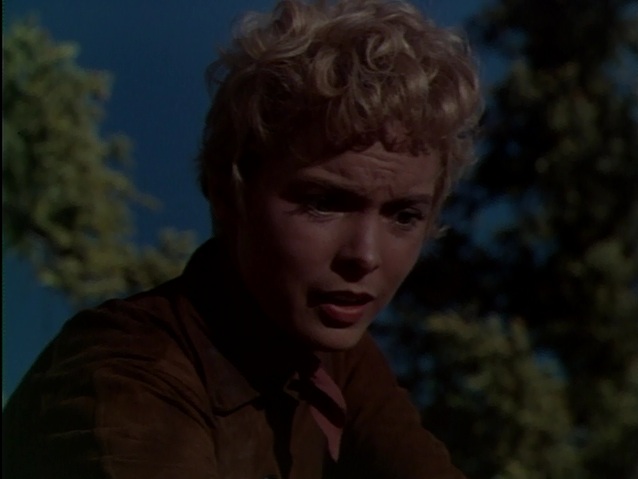
Leigh's character Lina originally came to Kansas hoping to live with her father. When she found that he'd been killed (while trying to rob a bank, we infer), she was taken in by his good friend, Ben. Smart, spunky, tough yet vulnerable, Lina serves as the moral compass for the film. Over the course of the movie, her allegiance shifts from Ben to Kemp as she discovers the true nature of each man.
This shift begins subtly. When Roy sets off a gunfight with a party of Indians (they started hunting him after he raped their chief's daughter), Kemp protects her. She returns the favor by pulling him to safety after he gets shot in the leg. She also nurses him when he falls unconscious from his wound.


 As Lina stays up all night tending to Kemp, the change truly begins. He grows delirious and starts to think that she's Mary, the woman he loved who betrayed him, sold his ranch and used the money to run off with another man. Lina plays the part in order to soothe him and keep him calm. Leigh's delicate handling of this scene allows us to infer that a seed is being planted in her character's mind as she takes on this role: Lina has taken one step away from Ben and toward Kemp.
In the scenes that follow, Leigh conveys largely through looks, nuances in her tone and little gestures that her character is warming more and more to this man. Kemp responds in kind, and we see some of the Jimmy Stewart we recognize start to come back. Thanks to the skill of both Stewart and Leigh, Kemp and Lina's deepening relationship and the glimmer of redemption within it feel not sentimental but hard-earned. This gives great power to The Naked Spur's ending, where Kemp must decide whether to go back to Kansas to collect his blood money or to start a new life with Lina.


